

 Basket
If you have vision problems and want to engage in sports, you must have asked yourself at some point: how to adapt my vision during my cycling outings? To help with this, we'll explore in this article which cycling glasses to choose for cycling.
Why should you wear glasses when cycling?
When cycling, regardless of the discipline, our eyes can be exposed to various projections (dust, gravel, mud, insects, etc.) and also branches when mountain biking. The sun is also considered an external aggression for your eyes. It is therefore important to protect your eyes by wearing glasses, even if you have no vision problems.
Cycling glasses are specifically designed for this sport. Thanks to their larger surface, they offer perfect coverage and increased vision due to an extra-wide field of vision. Additionally, thanks to their materials, they are very lightweight and non-slip so they don’t slide down your nose because of sweat. Not to mention, like regular sunglasses, they will provide you with excellent protection against UV rays.
Can you use cycling glasses if you have vision problems?
Contrary to popular belief, when you wear prescription glasses daily, it is entirely possible to use a pair of cycling glasses to adopt the perfect cyclist look. Either you can wear contact lenses and then choose from the many models of cycling glasses; or you must wear glasses and in that case, you'll need a pair of cycling glasses with corrective lenses.
Sports glasses – also designed to be lightweight and durable – can also be suitable in some cases, but we advise against using your regular prescription glasses or your usual prescription sunglasses, which are not adapted to the sport of cycling and could even be dangerous in case of a fall, for example.
Which system to choose for having cycling glasses with your prescription?
If you need to wear cycling glasses with corrective lenses, you will have two systems to choose from, allowing you to find the right glasses for your nose:
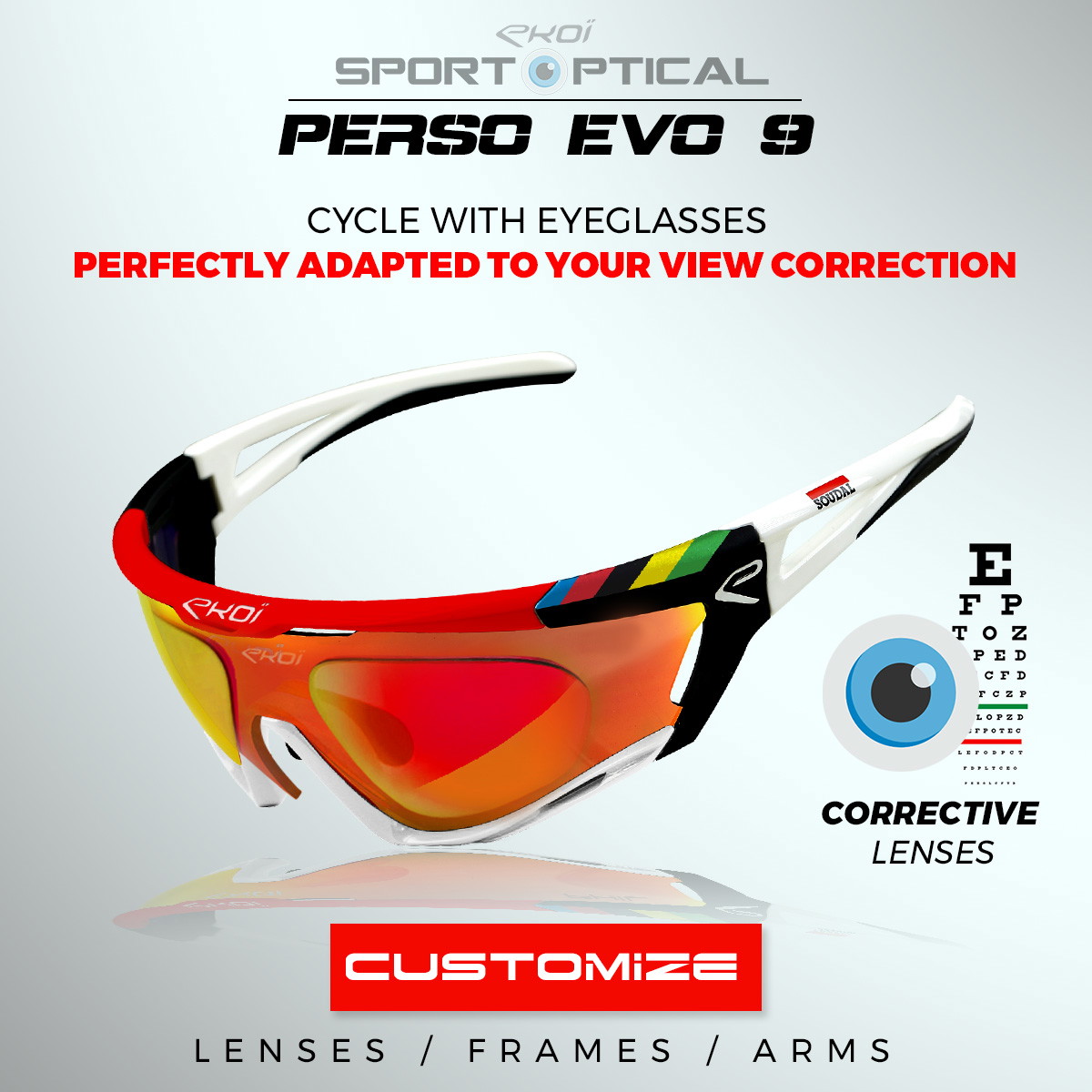
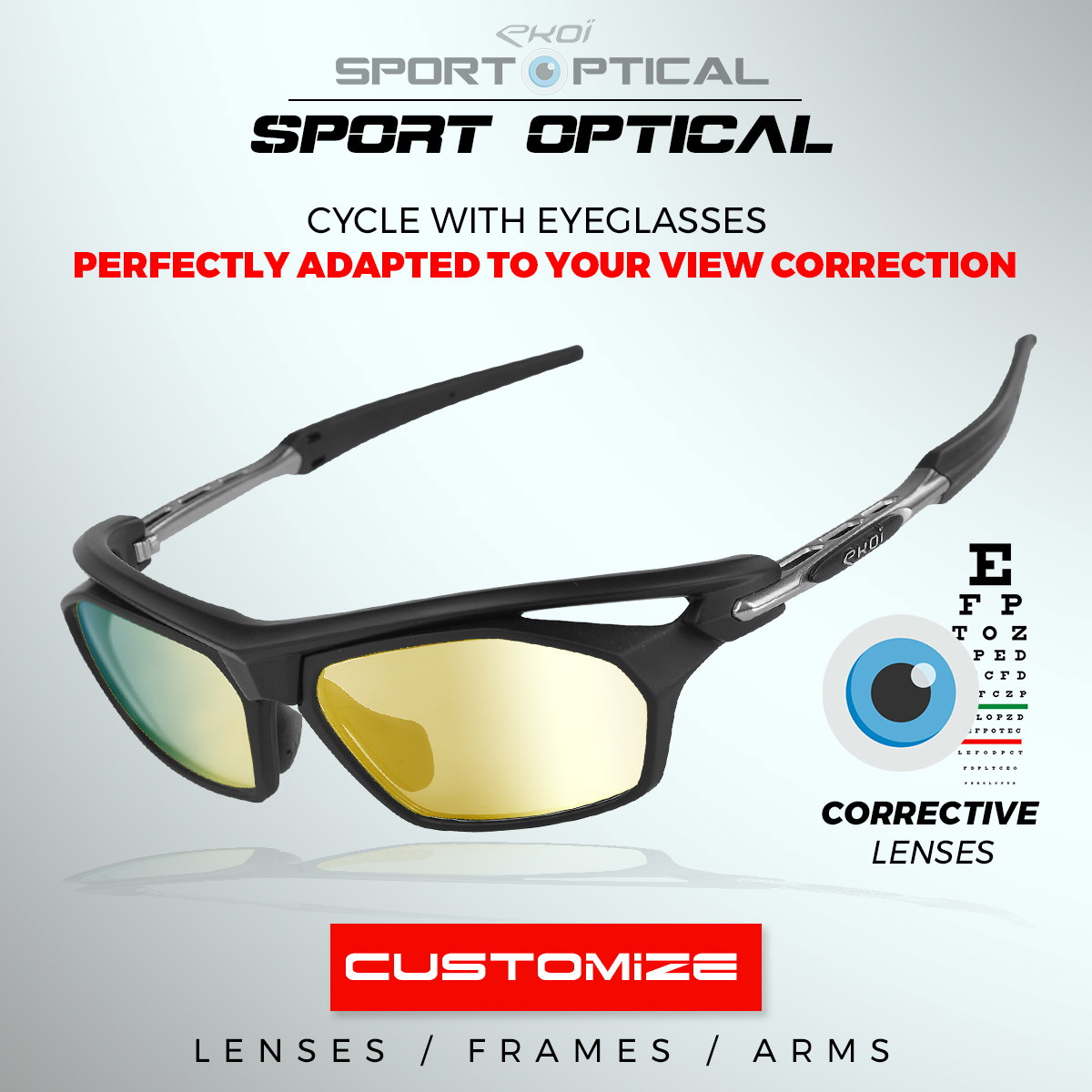
- Cycling glasses with corrective lenses;
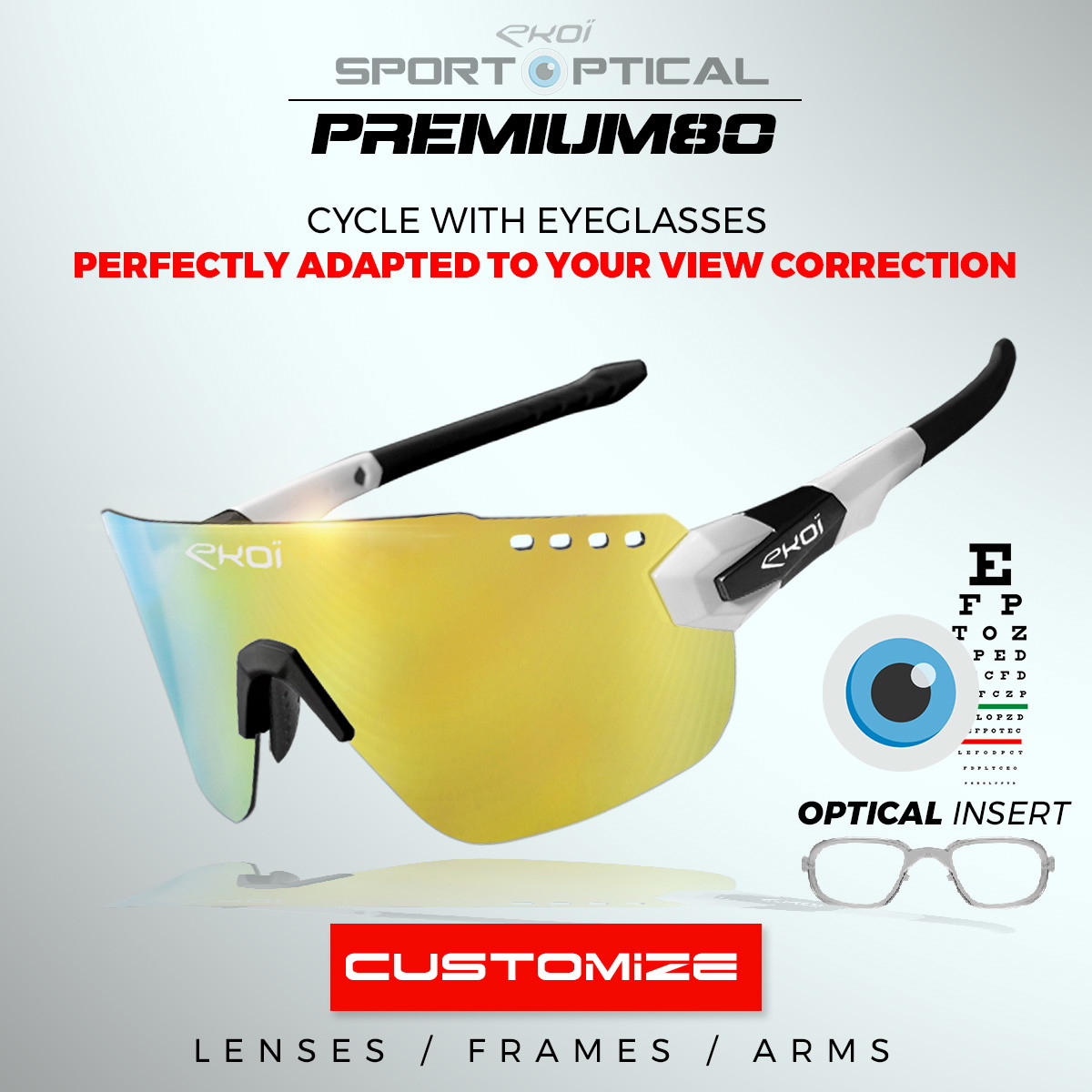
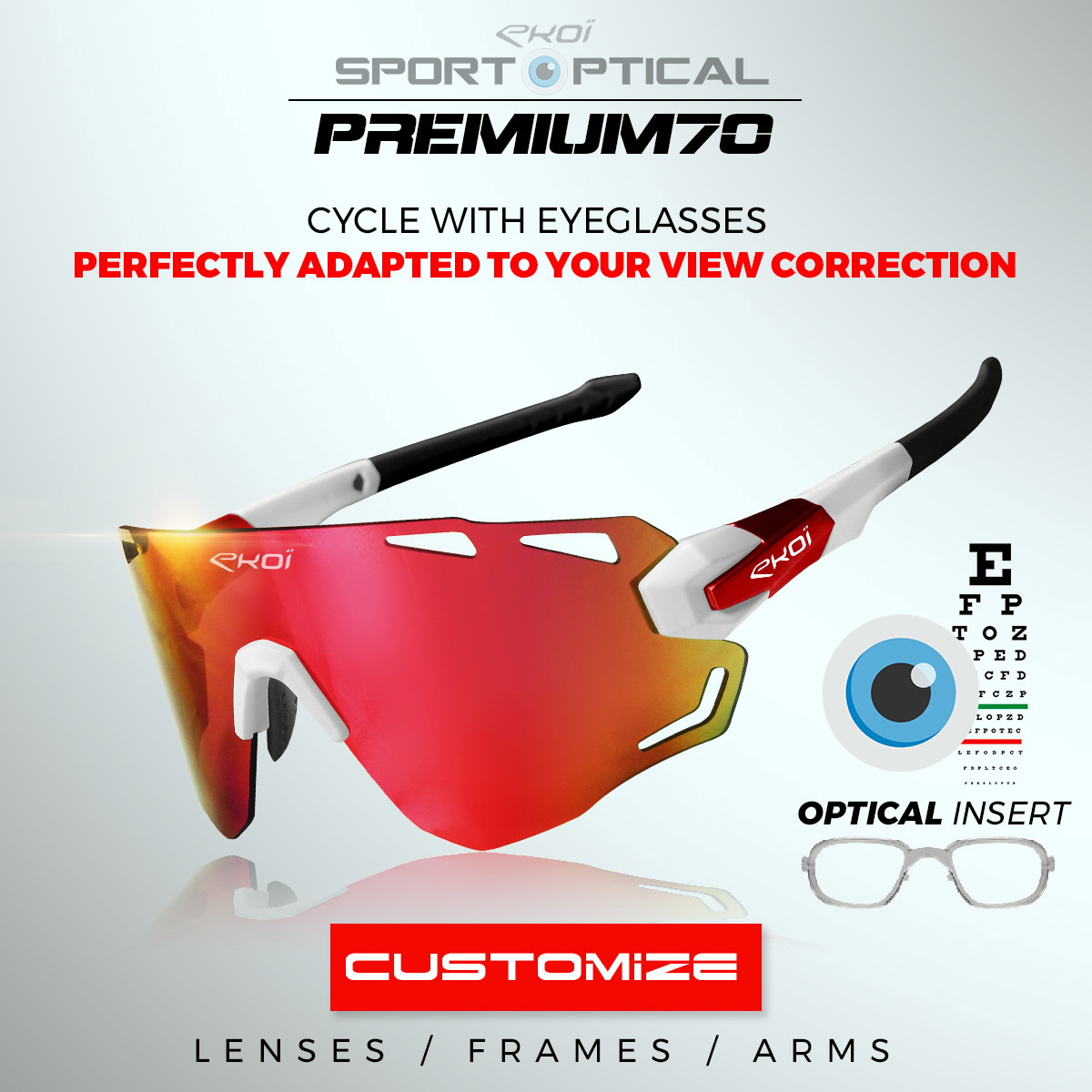
- Cycling glasses with optical inserts.
The choice between one system or the other will depend on the glasses model chosen, your preference, and your budget.
Optical inserts include corrective lenses fitted to your vision and clip inside the glasses, on the nose bridge, between your eyes and the outer lens of the glasses. They are quite affordable and can be more economical if your vision is not stable and you need to frequently change your glasses: indeed, the cost of optical inserts is lower than that of cycling glasses with corrective lenses. Additionally, if you sometimes wear contact lenses, you can easily adapt your glasses by removing the optical clip.
However, optical inserts are quite small, their field of vision is more restricted: if you wear progressive lenses, we recommend opting for models with corrective lenses for more comfort. Moreover, due to the two layers of lenses, the risk of fogging is higher than with a standard model.
Cycling glasses equipped with corrective lenses offer a larger vision surface and are lighter. Additionally, fogging is reduced compared to models with optical clips thanks to better ventilation.
However, for people who need a strong correction, cycling glasses with corrective lenses may not be adaptable to your vision.
How to choose your glasses for cycling?
Once you've chosen the glasses system, you need to choose your glasses model. This choice depends on several criteria: your practice (road cycling, mountain biking, etc.), the weather (clear, cloudy, etc.), lens technology (photochromic, polarized, etc.), etc.
Firstly, there are two main types of frames among the many models of cycling glasses:
- Half-rim frames (without lower edges);
- Full-rim frames (where the frame surrounds the entire lens).
The half-rim frame has the advantage of being lighter and offering an extra-wide field of vision, ideal for road cycling. The full-rim frame, a bit heavier, is more rigid and therefore more durable, which is ideal for mountain biking, for example, where there are many jolts.
Most models are equipped with a non-slip bridge on the nose and temples to ensure an excellent fit despite sweat and vibrations. The flexible temples can be adjustable on some models for a perfect fit.
The lenses of sunglasses or cycling glasses are available in several categories, meaning different tints, to adapt to all weather conditions:
- Category 0: these are clear lenses reserved for rainy weather or night riding as they filter very little light;
- Category 1: these are slightly tinted lenses, to be used on cloudy days when the light is low;
- Category 2: these lenses are for use when the sky is partly sunny and the light is moderate;
- Category 3: these lenses offer optimal UV protection and are the most used as they are suitable for most situations when the light is strong.
Some pairs of glasses allow for the use of interchangeable lenses to adapt to all situations, winter and summer.
In terms of lenses, there are several technologies. Some can be very useful for cycling:
- Photochromic lenses: they offer great versatility as they automatically adapt to ambient light by changing from one category to another in a few seconds, thus avoiding the purchase of multiple pairs;
- Polarized lenses: they enhance contrast perception and offer better visual comfort by eliminating 99% of glare on surfaces such as water or the road;
- Tinted lenses: tinted lenses can be useful in certain situations. Yellow-tinted lenses increase contrast when the light is low: they can be useful in winter or at dusk. Brown-tinted lenses enhance contrast and reduce brightness for use in full sun. Gray-tinted lenses do not alter colours and are therefore the neutral lenses par excellence.
When to change the sleeves of your glasses?
Some spare parts can be replaced on cycling glasses. If you are wondering when to change the sleeves of your glasses, know that it is possible to do so when they are too damaged rather than changing your pair of glasses.
Now that you know which prescription glasses to choose for cycling, how about finding out whether to prefer glasses or contact lenses for cycling?